
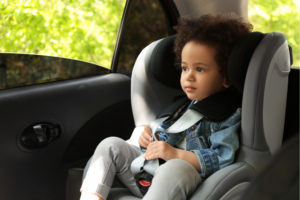
According to the Child Passenger Protection Act, children who are under the age of 12 have to ride in a car seat. The law was changed from 8 years to include 12-year-old’s under the consideration children grow at different rates. As parents, you need to familiarize yourself with these laws, so you don’t accidentally violate laws during a long drive, to grandma’s place or anywhere you take your kids in the car.
According to state law, if you are transporting a child who is younger than eight, you are liable for their safety. That means you need to ensure they are properly secured in the relevant child restraint system, such as a booster seat. This must be done whether your car has air bags or not.
This includes children who are younger than 16 years of age – according to the law, they must remain secure in the back seat with lap belts. This includes children who are under eight years of age and weigh more than 40 pounds IF there is no booster seat available to accommodate their size.
Similarly, children who are under two years of age have to be secured in a rear facing harness system. The only exception is children of this age who weigh over 40 pounds or are at least 40 inches tall. They can be secured with a forward facing seat.
Besides ensuring your children are secure in the back seat with the appropriate restraint systems, you also have to wear an adjustable seat belt while driving them around. This involves any driver who is under 18 years old who has a graduate driver’s license or until they reach 18 years of age. Plus, they cannot drive with more than one person who is under 20 years old.
It is the responsibility of the driver to ensure every passenger, young and old obeys safety belt laws and the provisions in the Child Passenger Protection Act. In case you are involved in an accident and the passengers are not secure, you will be the one held liable for their injuries.
If you secured your children properly and they were injured because of an accident, you can sue for damages if the guilty driver refuses to pay. If you find yourself in such a situation – whether you had passengers with you or not – get in touch with Bob Edens at the Law Offices of Robert T. Edens. Bob and his staff are dedicated when it comes to representing auto accident victims in Illinois. We offer our services in Chicago, Waukegan, Woodstock, Libertyville and Antioch, IL. Get in touch for a consultation today.

If you are injured in a store in Illinois, you can receive compensation whether you are or aren’t at fault for the accident. This is according to the state’s comparative fault law in which the value of the settlement is based on the percentage of the fault.
Understanding the Comparative Fault Law
According to the law, you can collect damages even if the accident is partly your fault and the court can adjust the settlement accordingly. This is determined by the modified comparative fault rule.
To understand this law, let’s take a simple example. Say you are shopping in a grocery store and are reading the label on a can without looking where you are going. If you trip and injure yourself in this case, you will be partly at fault for your injuries.
As a person who is in charge of all of his/her mental and physical faculties, you have a duty of care to prevent such incidences. However, even in this case, you will be 5 percent at fault and the store will be 95 percent at fault. (If you slipped on a wet spot that wasn’t cordoned off properly, you may be eligible for more). If you are awarded $100,000 by the court and it is reduced by 5 percent, you will receive a generous $95,000 in compensation.
However, if the court determines you were 50 percent responsible for your injuries, that amount will be split in half and you would receive $50,000 in compensation. If you are more than 50 percent responsible, the verdict may be in favor of the store owners.
You have two (2) years from the date of the accident to file a personal injury claim with an attorney for your claim to be valid. In some cases, the statute of limitations may start running from the date you discovered your injuries from the accident (such as internal bleeding or a hairline fracture).
If you suffered a traumatic brain injury from the accident, you deserve each penny you receive from the store owners. The consequences of this injury can be life-altering and lifelong in some cases. Get in touch with us at The Law Offices of Robert T. Edens for a consultation today. We offer our services in Chicago, Waukegan, Woodstock, Libertyville and Antioch, IL. Our cases are usually retained on a contingency fee basis and we won’t even ask for it until you recover fair damages from your case.
While there is no law in Illinois that deals with how a pet should occupy a vehicle, that doesn’t mean they cannot prevent an accident during a trip. If a pedestrian or another driver is injured or suffers property damage because you can’t control your animals in your vehicle, you will be held liable.
Travelling with your canine or feline companion can be fun, but not if your vehicle is unsuitable. You can increase your chances of accidents if you do not take a few precautionary steps beforehand. Here are certain things you should take care of to prevent a costly lawsuit:
Take A Test Drive Before the Road Trip
Before the big road trip, take your pet with you in the car for a test drive to acclimatize them to the car and the road. If they seem uneasy at first, take a short trip around the block the first day. Then increase the distance every day until the day of the trip. This should get your pets used to remaining in a moving vehicle and reduce their anxiety, which can otherwise make them panic.
Consider the Car Model
The type of car you drive should also affect the choices you make for your pet. For instance, if you own a SUV, make sure your cat or dog has a crate to sit in and in the back seat. Cover the seats to reduce damage using an old towel or a bed sheet. Your pet should always be in the back seat, regardless of the vehicle you have. That way, you will not take your eyes off the road – especially when your pet tries to get your attention.
Bring Toys and Treats
Of course, this does not mean that your pet should be ignored throughout the trip. For instance, if you have a puppy, it will not be able to remain still for long and will demand your attention. Prevent it from getting out of its crate by ensuring you take toys and treats with you. These will keep your pooch distracted and happy as you drive.
If you have been injured in a car accident in Illinois, The Law Offices of Robert T. Edens can help. We have been protecting the rights of accident victims for two decades and can ensure you get the compensation you deserve. Get in touch with us for a consultation in Chicago, Waukegan, Woodstock, Libertyville and Antioch, today. A team of legal professionals will be assigned to your case as soon as you make a claim with us.
Very few teens wait until they are older to get behind the wheel. However, without proper training, they can become hazards on the road. If the teen’s vehicle isn’t insured, you can end up paying out of pocket and have to pay a fine of $500 to $1,000 for not having insurance.

Before your teens get you into trouble, you need to make sure they are trained to drive a vehicle. What better way to do that than making them go through the state’s stringent licensing protocols?
Getting A Driver’s License in Illinois
You have to be at least 15 to be eligible for a driver’s license in Illinois. You need to complete three (3) stages and each requires a parent’s permission if you just turned 15. At that point, you can get an instruction permit with written consent from your parents or legal guardians. However, you have to earn it by passing a driver education course, a written test and a vision test.
Once you have the permit, you can drive, but only if you are accompanied by an adult who is older than 21 or a parent who has a valid driver’s license. Plus, they need to sit in the front passenger seat, not the back, and the vehicle should not accommodate more people than the number of seat belts it has.
New or teen drivers must accumulate more than 50 hours of driving, as well as 10 hours of night-time driving before they are allowed to move onto the first phase of the licensing procedure. However, you cannot drive all day to make those up. According to Illinois law, drivers who only have an instruction permit cannot drive:
Between 10 p.m. and 6 a.m. Sunday to Thursday.
Between 11 p.m. and 6 a.m. Saturday and Friday.
Once the driver turns 16 and does not have a conviction on their permit for at least nine (9) months, they can apply for their initial license. However, to get it:
Their guardian or parent of the driver must certify they completed the aforementioned hours.
They need to provide proof they completed a state-approved driving course, along with proof they graduated from an accredited high school or GED program.
Their parent or guardian has to go with them to the Driver Services facility to sign a form confirming their consent.
You need to pass a driving test.
However, even when you get your initial driver’s license, you are not out of the woods yet. You will need to follow certain restrictions by law, such as the time limits mentioned before. Additionally, for the first 12 months after you get your driver’s license or when you turn 18, you cannot have more than one passenger under 20 in the vehicle with you unless the other passenger is your sibling, step sibling, child or step child.
Even the best drivers can get into accidents. If you or someone you love has been hurt by one, you deserve to get the compensation need and deserve. If you face disputes from the insurance company or the other driver, get in touch with us at the Law Offices of Robert T. Edens today. We have more than two decades of experience successfully representing victims like you in court. Call us today in Chicago, Waukegan, Libertyville, Woodstock or Antioch, IL, and get the compensation you deserve.
Slip and fall accidents can be embarrassing but they can also be crippling and debilitating. If a slip and fall accident caused serious injuries, you can demand compensation from the owner of the property where you fell. However, to claim damages, you and your lawyer will have to prove the owner is liable for the injuries you sustained.

Hazard vs. Fault
Since they have a duty of care to ensure no one is physically hurt on their premises, property owners need to take appropriate precautions. Besides proving the owner violated this duty, you also need to prove the condition that caused your slip and fall was hazardous. Unless you have an experienced attorney in your corner, this can be challenging to prove to a judge.
That’s because even though the condition may seem hazardous to your eyes, it may not seem like that to a judge. Legally, it can be deemed hazardous if conditions pose a foreseeable risk of harm. This can include icy sidewalks, broken tiles or uneven walkways. Besides proving this, you also need to show evidence the condition caused your accident.
Once the condition is deemed hazardous, you may be asked the following questions when it comes to determining fault:
Did the accident occur because you were engaged in an act that prevented you from noticing the hazard? This can be anything from texting to engaging in a phone call.
Were you trespassing on the property or was your presence legal? Plus, did you have a legitimate reason for being on the property?
Did you ignore signs that were put up to warn people about the hazardous condition?
Was there a reasonable way to proceed, which could have reduced your chances of slipping and falling because of the condition?
The proof you provided will determine whether you have a good case or instead, held liable by the owner. Whatever the case may be, you have two (2) years from the date of the accident to file your claim in court for it to be valid. The clock will start running on the date the accident occurred, not the date you file the claim.
You should act quickly if you want to give yourself enough time to file a successful lawsuit – even if you know you have a solid case. If not, the claim will at least give you leverage during the settlement discussions.
If you or someone you know has been injured in a slip and fall accident, get in touch with a lawyer at the Law Offices of Robert T. Edens today. We have been protecting the rights of victims for years and have a great track record for successful cases. If you are confused as to who is liable for your injury, we can help you clear all concerns.
Why would you leave money that you can use for your own recovery and rehab? Call us today in Chicago, Waukegan, Libertyville, Woodstock or Antioch, IL, and get the compensation you need and deserve.
If you live in Illinois and own a dog that tends to bite, you either need to ensure it is well-behaved or keep it inside. When it comes to dog bite cases, according to the Animal Control Act, Illinois is a strict liability state and any injuries caused by your animals may be your responsibility.

You cannot argue you had no idea your pet was aggressive or could injure someone – even if it never exhibited such previous behavior. If your pet injures another person or their pet and caused injuries, you will be held liable as its owner.
Dangerous vs. Vicious Dogs
State law categorizes liable dogs as either dangerous or vicious depending on the severity of the attack. The former is a dog that is not on a lease, muzzled or was unattended by the owner and behaved in a manner resulting in the injury or death of another. This includes dogs that bite others without reason but does not cause a physical injury.
A dog is deemed vicious if it attacks someone without provocation leading to serious injuries and/or death. Dogs that have been deemed dangerous by the state three (3) times are also deemed vicious.
Responsibilities of Dog Owners
In the state of Illinois, dog owners have certain responsibilities that they need to upheld or their dogs may be deemed vicious or dangerous. For one thing, their pets always have to be in your sight, leashed if they are outside and muzzled if they are prone to aggressive behavior.
If the dog is not on the owner’s property, the owner has to ensure his/her pet is kept in an enclosure that can prevent an escape. The enclosure should also be sturdy enough to prevent children from entering. Owners are liable for injuries caused due to certain circumstances:
Their dog tried to attack or successfully attacked the victim
The victim had every right to be in the location where the attack occurred
The dog was not provoked by the victim or caused the attack
In other words, the only way dog owners can legally claim they are not responsible for an attack is if their dog was provoked into an attack (i.e. it was teased and beaten) or the victim trespassed on their property, which led to the attack. If not, the victim has two (2) years from the date of the incident to bring their claim to court or risk forfeiting their claim.
If you are a victim of a dangerous or vicious dog attack, get in touch with us at the Law Offices of Robert T. Edens today for a consultation. We have successfully represented cases like yours in court for the past 20 years and have recovered millions of dollars in settlements for our clients. The call is completely free. Once you book an appointment, we will sit down with you to discuss the details. Call us today in Chicago, Waukegan, Libertyville, Woodstock or Antioch, IL, and get the compensation you deserve.
Responsible drivers can avoid hefty fines in Illinois. For example, if you text while driving and your actions caused great bodily harm to another, you can lose your license for a year and have to pay a $1,000 fine, according to the new bill that was signed to fine driving violations.

These new penalties apply to all tablets, laptops and other hand-held devices you use while driving. They don’t apply to drivers who are reporting emergencies to emergency personnel, those using hands-free or voice-activated modes or drivers who are parked in neutral on the side of the road or in traffic.
The new law comes into effect July 2020 so take measures to prevent violations and avoid accidents by following these tips:
Keep Your Eyes on the Road
Keep your eyes on the road when you are behind the wheel – it’s no place for multi-tasking. This includes brushing your hair, applying makeup, eating or shaving. If you try to do more things, your attention will not be focused on possible obstructions or pedestrians in front of your car. The best way to ensure your eyes remain on the road is by ensuring your hands are in the 9 and 3 o’clock position on the wheel. This will automatically make your brain pay attention.
Don’t Use your Cell Phone
If you don’t have a hands-free device, an incoming call or text can wait – even if it is from your boss. If you still pick up that call, you will take your eyes off the road, especially when you must look down to text or dial a number, which can cause an accident. So make sure your phone is either on silent mode or shut down while you are traveling in your vehicle and only turn it back on when you reach your destination and are off the road.
Don’t Drive Angry
Your mind should be at peace when you are driving. Anger gives us tunnel vision, which results in blind spots, which can hide oncoming cars or pedestrians. Plus, you will drive more aggressively when you are upset, which can increase your chances of getting into a car accident. According to the law, aggressive driving can also lead to hefty penalties – especially if you have been repeatedly involved in such cases. It’s better to be safe than sorry in this case.
Get Compensation for Car Accident Claims
Even the most responsible drivers can fall victim to erratic drivers on the road. If they refuse to pay for damages, you have the right to retain an attorney. If you find yourself in such a situation, get in touch with us at the Law Offices of Robert T. Edens. We have a team of professionals working to protect your rights. Call us today in Chicago, Waukegan, Libertyville, Woodstock or Antioch, IL and get the money you need and deserve. The call is free and the advice will prove invaluable for your case.
As our dependence and addiction to smart devices take over our lives, hit and runs have become a common occurrence. With people glued to their cell phones, people fail to look both ways before crossing the street or see pedestrians in time to slow down. The good news is if you are involved in an accident like this in Illinois, you are protected by law – provided you are not the negligent party. Here are some you should be aware of:

Pedestrian and Driver Rights under Illinois Traffic Laws
In the state, pedestrians have the right of way at crosswalks. Oncoming cars must yield to them if they cross a road with a signal. If they cross the road from a point that does not have a crosswalk, they still have this right, even if they are breaking the law by doing so. Drivers must be mindful of pedestrians and avoid a collision.
According to the law, pedestrians have this right over any vehicle that stops at an intersection which has a crosswalk or a red signal. If pedestrians wish to cross the road that does not have a crosswalk or has an unmarked crosswalk at its intersections, they must give right of way to oncoming vehicles.
Pedestrians will break the law if they walk on or along the side of the road when a sidewalk is available to use. Also, if pedestrians are under the influence of alcohol or a drug while crossing and are a hazard, they should remain on the sidewalk.
Drivers who see pedestrians crossing the road have a duty of care to avoid colliding with them and to warn them by sounding their horns. They also must exercise caution in case a pedestrian is a child or an elderly person who may be confused or disoriented.
If a pedestrian is hit by a car, they can file a lawsuit against the driver for damages – if the driver was at fault. However, they have two (2) years from the date of the accident to make their claim or lose their right to sue. By filing a lawsuit as soon as the accident occurs, they can increase their chances of winning their case as long as they have an experienced attorney in their corner.
If you were involved in a hit and run accident and suffered injuries or other damages, get in touch with us at the Law Offices of Robert T. Edens, P.C. We have been fighting for the rights of auto accident victims for two decades and have perfected our negotiation skills.
The attorney on your case will review the events surrounding the accident from the time it happened and ensure you get the full compensation you deserve and need. Insurance companies don’t intimidate us, we intimidate them because we are dedicated to protecting your rights. Call us today for a consultation and get the money you deserve. You can reach us at our offices in Libertyville, Waukegan, Woodstock and Antioch, Illinois.
According to the U.S. Bureau of Labor Statistics, more than 5,250 workers died in the workplace after sustaining burn injuries in 2018. This was a 2% increase from the 2017 consensus. This increase is a cause for concern for workers in a range of industries.
Burn injuries may seem minor, but they can be incredibly painful. If the burn covers most of the body, it can prove fatal as the healing process weakens your body.
Plus, since burns cause significant damage to the skin, which is our first line of defense against bacteria, a victim can get an infection faster than a healthier person. That, along with the disfiguring scar tissue that burns leave, can affect victims physically and emotionally. Needless to say, returning to work is not an option.
Types of Workplace Burns
There are four types of burns a worker may experience in the workplace:
1st degree burns: This burn can take off a layer of skin and cause redness, but the injuries are superficial and can heal well. A common example is a burn caused by grabbing a hot pan (such as in a restaurant kitchen).
2nd degree burns: This burn damages the first and second layer of skin, which can cause blisters and swelling. A good example is a burn caused by scalding water, a hot iron, hot oil or a serious sunburn.
3rd degree burns: This is a serious and debilitating burn anyone can get. It damages both layers of the skin right down to the tissue underneath the skin. The burn is followed by intense pain and the burnt area can turn stiff and leathery. Common examples include burns from open cooking fires, electrical burns from exposed wiring, radiation burns, etc.
4th degree burns: This burn is usually life-threatening because it goes right to the muscles, bones and tendons. You can sustain one if you are caught in an office or warehouse fire and are unaware of safety exits, if any.
Occupations at Risk for Burn Injuries
Burn injuries are common in most workplace environments, but some are more susceptible than others. The following workers are exposed to hazards on a more regular basis in comparison to others:
Healthcare workers
Construction workers
Firefighters
Janitors
Mechanics
Food workers
Landscape workers
If you have sustained burn injuries in the workplace, you have the right to demand compensation from your employers. If you are denied workers’ compensation, get in touch with us at the Law Offices of Robert T. Edens P.C. as soon as possible. We have more than 20 years of experience representing and fighting for workers and know what it takes to ensure you get the compensation you deserve and need.
The first consultation is free of charge so you can have peace of mind. We will take a detailed look at your case and discuss with you the best course of action for your claim. Reach us at our offices in Libertyville, Waukegan, Woodstock and Antioch, Illinois.
Whether an injury is caused by a car accident or a dog bite, it may require a trip to the emergency room – and many other facilities, to get you to Maximum Medical Improvement (MMI). In addition to stress, pain and loss of employment, your injuries can place a serious strain on your finances – especially when you start to receive medical bills. If your injuries require surgery, you will likely spend months in recovery doing Physical Therapy (PT) and/or Occupational Therapy (OT), which will certainly result in a mounting pile of medical bills, which will make you question: Who is responsible for paying these bills?
The Negligent Party Determines the Compensation Amount
Ask yourself: Do you have money to take care of all the expenses associated with your injury? Fortunately, Illinois is a fault state, which means you can demand compensation from the responsible party. However, these cases can be complicated, and you may end up being denied compensation if you are found partially responsible for the accident which caused your injuries.
In this case, Robert “Bob” T. Edens, an attorney with more than 27 years of experience in representing clients who have been injured as a result of the negligence of others, can fight for your rights. Bob can put his years of experience to work and help you understand your responsibilities and how the at-fault driver can be forced to pay you the most amount of money you deserve for you injuries and, if necessary, your property damage.
Illinois is a contributory fault state, which means the damages you can recover from the at-fault party are reduced by the amount of negligence that can be assigned to any other party, including yourself. For example, if you were in an accident where a vehicle in front of you struck another vehicle that was pulling out from a private drive, who could be held liable for the accident? The answer, most likely, would be the vehicle pulling out of the private drive. However, if the vehicle in front of you was distracted due to texting on his/her phone and could have stopped, that driver could also be held liable. Finally, if you were tailgating the vehicle in front of you, you could also be can be held liable.
Although they may act like it, insurance adjusters are not the final word on how fault will be allocated amongst responsible parties. The allocation of fault is determined by the judge or jury after hearing all evidence. Anything you say to the insurance adjusters can and will be used against you. Therefore, except for the adjuster assigned to your case from your own insurance company, it is in your best interest to call Bob Edens and get a free consultation before giving any insurance adjuster a recorded statement.
Any statement you provide to an adjuster from an insurance carrier, other than your own insurance carrier, will result in them using your statement to allocate less fault on their insured and more fault on you. Simply put, if the judge or jury finds that you were 50 percent at fault for the accident, you may not receive compensation. However, if you are found to be less than 50 percent at fault, the total amount of damages you receive will be reduced by the percentage of fault attributed to you.
In order to win a claim based on the negligence of another party you must prove four (4) things:
The defendant owed a duty to do something or refrain from doing something, AND;
The defendant failed to do what he/she was supposed to do, or did what he/she was supposed to refrain from doing, AND;
The defendant’s failure to do what he/she was supposed to do, or he/she failed to refrain from doing something resulted in you being damaged in some way, AND;
What damages and/or injuries were caused by the defendant’s failure to do what he/she was supposed to do, or as a result of the defendant’s failure to refrain from doing something he/she was supposed to refrain from doing.
If the defendant refuses to pay damages, despite being guilty of all the above elements, you can file a complaint against the at fault individual or company. Their insurance carrier will hire an attorney for them and pay any damages a judge or jury imposes up to the limits of the policy of insurance in most cases.
Illinois’ No-Nonsense Dog Bite Law
However, this does not mean Illinois treats all personal injury claims the same. To understand how seriously the state takes personal injury claims, just take a look at its strict dog bite laws.
Unlike other states where most dog owners are protected from liability the first time their pet bites someone, dog owners in Illinois are strictly liable the first time around. In other words, even if their dog has never exhibited aggressive behavior, owners are responsible for any injury they cause to other people.
This will be the case if their dog attacks or tries to attack another person without provocation – wherever they are. The injuries resulting from the attack are damages the dog owner must pay to the injured party.
Whether you were injured because you slipped and fell on someone’s property or because of a dog attack, get in touch with the Law Offices of Robert T. Edens P.C. today. We have been representing and protecting the rights of our clients for more than 20 years and are conveniently located in Libertyville, Waukegan, Woodstock and Antioch, Illinois.