If a driver looks at their phone for just a few seconds, they can cover the length of a football field without really watching the road. When this leads to a serious crash, proving that distraction was involved is often harder than simply suspecting it. Most drivers in Antioch do not admit to reading texts, entering addresses, watching videos, or checking social media right before a crash. Some might tell police they did not see the other car or that traffic stopped suddenly, without saying what distracted them.
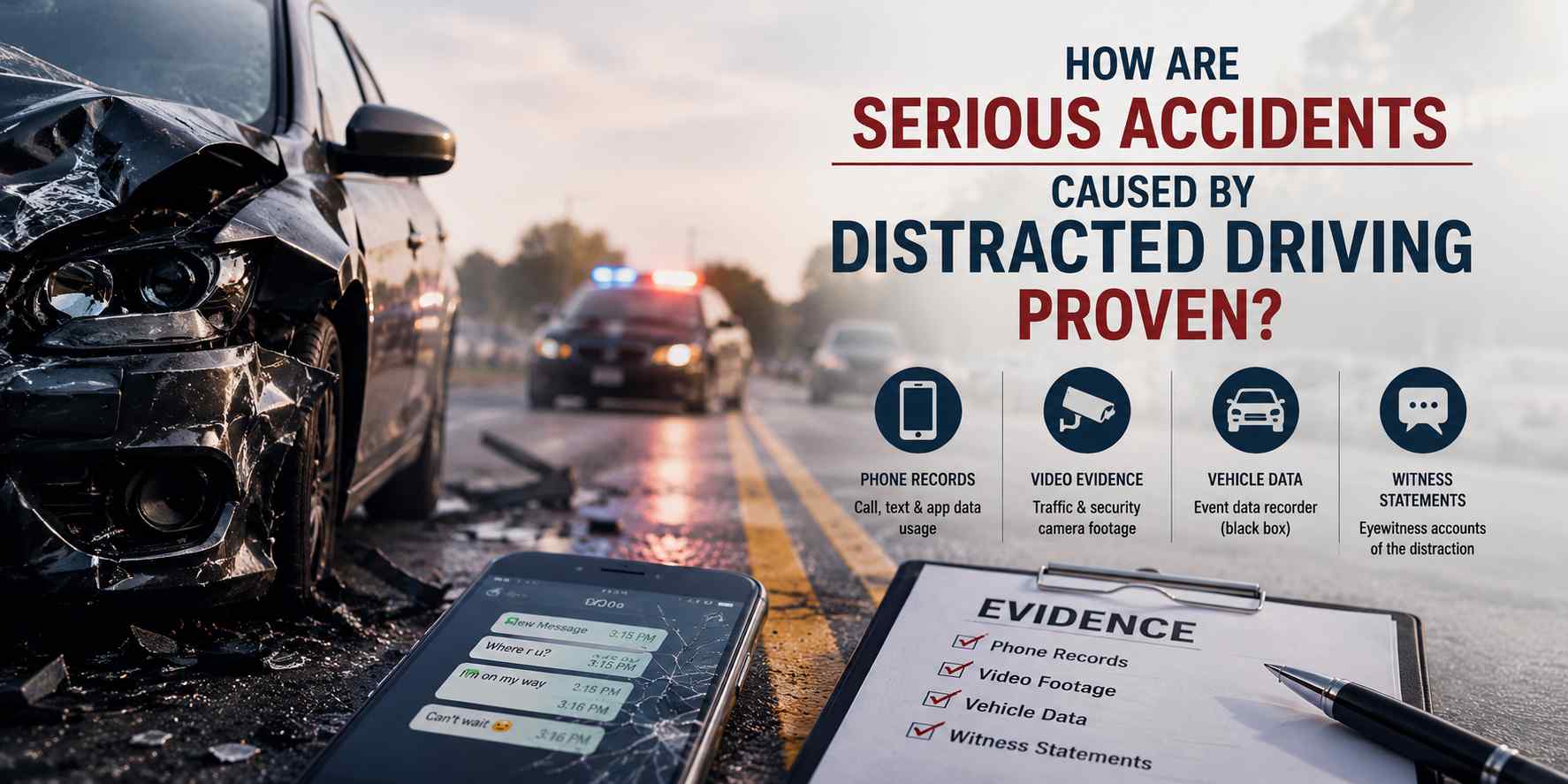
At The Law Offices of Robert T. Edens, P.C., we look at all the evidence from serious Illinois crashes to find out if distraction played a part and if that evidence can show negligence. Building a case may involve gathering phone records, electronic data, witness statements, video footage, vehicle details, and physical evidence from the scene.
Distracted driving means doing anything that takes your eyes, hands, or mind away from driving safely. While cellphone use gets a lot of focus, distraction can also include texting, using a navigation app, reading emails, checking social media, watching videos, eating, talking to passengers, or handling things inside the car.
Illinois law specifically restricts the use of electronic communication devices while driving. Under 625 ILCS 5/12-610.2, a driver generally may not operate a motor vehicle on a roadway while using an electronic communication device, subject to statutory exceptions. Illinois law defines covered devices broadly and permits certain hands-free or voice-operated uses.
The statute also carries greater consequences when prohibited electronic-device use results in an accident causing great bodily harm, permanent disability, disfigurement, or death.
A traffic ticket can be important evidence in a civil injury case, but we do not stop our investigation there. A driver can still be negligent because of distraction, even if their actions do not break a specific cellphone law.
Phone use often leaves a digital record. Depending on the situation and what evidence we can legally get during a lawsuit, these records may show what happened around the time of the crash.
We might look for evidence about calls, messages, app use, data transfers, photos, or other digital activity. How helpful these records are depends on what they show. For example, a phone company record showing a data connection does not always prove the driver was actually using the phone.
Timing is very important. We compare electronic evidence with the reported time of the crash, 911 calls, vehicle data, photos, video footage, and witness statements. Our goal is to build a clear timeline, not just show that the driver had a cellphone.
When necessary, litigation procedures may be used to obtain records that are not voluntarily produced. Preserving this evidence early can be important because different sources retain electronic information for different periods.
A text sent seconds before impact can be powerful evidence, but modern distracted-driving investigations can extend far beyond traditional SMS messages.
Drivers use messaging apps, social media, email, work apps, and other services. They might also use navigation, streaming, websites, or take photos right before a crash.
When legally relevant and obtainable, timestamps and other electronic records can help establish what occurred. We also consider whether the driver made statements about phone use after the crash.
Evidence must still be placed in context. A received message does not prove that the driver read it. A notification appearing on a device does not necessarily prove interaction. Our task is to connect the available digital evidence with the driver’s conduct and the mechanics of the crash.
Eyewitness testimony can provide evidence that electronic records cannot. A passenger may have seen the driver typing. Someone in an adjacent vehicle may have noticed the driver’s head pointed downward. A pedestrian may have seen a phone in the driver’s hand immediately before impact. Another motorist may have observed the vehicle drifting between lanes, failing to respond to a traffic signal, or traveling into stopped traffic without braking.
Statements made immediately after the collision can also matter. A driver who says, “I looked down for a second,” may have provided an important piece of the case even without expressly admitting to texting. We work to identify witnesses promptly because memories fade and witnesses can become difficult to locate.
Video evidence has become increasingly important in serious car accident cases. Businesses, residences, traffic areas, buses, commercial vehicles, and private motorists may have cameras that captured part of the collision. Dashcams may record how long a vehicle failed to brake, whether it drifted out of its lane, or whether the driver was visibly looking downward.
In some cases, footage may show the driver’s face or hand position through a windshield. In others, the video establishes driving behavior consistent with inattention rather than showing the actual source of the distraction.
Video can disappear quickly. Some systems automatically overwrite footage within days or weeks. When we investigate a serious crash, identifying potential video sources and seeking preservation can therefore be time-sensitive.
Modern vehicles can contain electronic information that helps reconstruct what occurred immediately before a serious collision. Depending on the vehicle and circumstances, event data recorder information may provide evidence concerning speed, braking, throttle position, seatbelt use, and other parameters around the crash. Other vehicle systems may contain additional relevant information.
Suppose traffic was stopped at a red light and the at-fault vehicle struck the rear of another vehicle at substantial speed. Evidence showing little or no braking before impact may support the argument that the driver failed to perceive an obvious hazard. That evidence does not necessarily identify why the driver failed to react. When combined with phone activity, witness testimony, or video, however, it may become part of a much stronger distracted-driving case.
The vehicles and accident scene also tell a story. Skid marks, impact locations, debris patterns, roadway conditions, vehicle damage, sight distances, and final resting positions may help reconstruct the collision. Photographs taken immediately after the accident can preserve details that disappear once vehicles are moved and the roadway is cleared.
A serious crash may also require accident reconstruction. Reconstruction evidence can help determine speed, reaction time, braking, movement, and whether a reasonably attentive driver likely had enough time to avoid or reduce the severity of the collision. We use this evidence together. A distracted-driving case is often strongest when several independent sources point toward the same explanation.
Showing that someone was looking at a cellphone does not complete the civil case. We must connect the distracted conduct to the collision and resulting injuries. Generally, an Illinois negligence case requires evidence supporting a duty owed to the injured person, breach of that duty, causation, and damages. A driver who looks at a phone but is struck by someone who runs a red light presents a very different causation question from a driver who is texting and rear-ends stopped traffic.
We therefore establish not only that distraction occurred but that the driver’s lack of attention caused or contributed to the accident. Medical records, diagnostic studies, physician testimony, wage records, photographs, and other documentation may then be used to establish the harm resulting from the crash.
Insurance companies frequently respond to serious accident claims by arguing that the injured person also contributed to the collision. Illinois uses modified comparative negligence. Under 735 ILCS 5/2-1116, an injured plaintiff whose contributory fault is more than 50% of the proximate cause of the injury is barred from recovering damages. If the plaintiff’s fault is 50% or less, damages are reduced in proportion to the plaintiff’s percentage of fault.
For example, if a jury determined that an injured driver sustained $500,000 in damages but was 20% at fault, the recoverable damages would generally be reduced by 20% to $400,000.
We therefore investigate allegations against our client as carefully as we investigate the distracted driver’s conduct. Evidence proving what happened before impact can help counter an insurer’s attempt to shift responsibility.
Distracted drivers can cause high-speed rear-end crashes, intersection collisions, pedestrian accidents, bicycle collisions, and head-on crashes. The resulting injuries may include traumatic brain injuries, spinal cord damage, fractures, internal injuries, permanent impairment, and disfigurement.
Illinois law allows an injured person to seek compensation for legally recoverable damages resulting from another person’s negligence. Depending on the case, those damages can include medical expenses, lost income, diminished earning capacity, pain and suffering, disability, disfigurement, and other proven losses.
Illinois generally does not impose a statutory cap on ordinary compensatory damages in car accident cases. Every claim, however, must be supported by evidence connecting the claimed losses to the accident.
Time matters for both the lawsuit and the investigation. Under 735 ILCS 5/13-202, actions for damages for injury to the person generally must be commenced within two years after the cause of action accrued. Different rules and shorter notice requirements can apply in certain cases, including some claims involving governmental entities, and particular circumstances may affect the limitations analysis.
Waiting can also result in lost evidence even when the filing deadline is still months away. Video can be overwritten. Vehicles can be repaired or destroyed. Witnesses can become unavailable. Electronic records may no longer exist. For that reason, we prefer to investigate serious distracted-driving crashes while the evidence is still available.
When distraction causes a serious accident, we do not have to rely solely on what the other driver chooses to admit. At The Law Offices of Robert T. Edens, P.C., we investigate the digital, physical, medical, and testimonial evidence that can establish what happened before the collision. We can work to preserve relevant evidence, identify witnesses, examine available electronic records, document your injuries, and pursue compensation from the parties legally responsible for your losses.
If you were seriously injured by a distracted driver, contact our Antioch distracted driver accident attorney at The Law Offices of Robert T. Edens, P.C. today at 847-395-2200 to schedule your free consultation. We represent accident victims in Antioch and throughout Illinois from our offices at 392 Lake St., Antioch, IL 60002; 325 Washington St., Waukegan, IL 60085; and 1212 North Seminary Unit 1, Woodstock, IL 60098. We can review the circumstances of your collision, identify evidence that may establish distracted driving, and discuss your options for pursuing compensation under Illinois law.

The Law Offices of Robert T. Edens, Personal Injury and Workers' Compensation Law Office, have offices in Antioch, Waukegan, Grayslake, Woodstock and Barrington. We represent clients throughout the communities of Antioch, Waukegan, Grayslake, Barrington, Woodstock, Buffalo Grove, Deer Park, Gurnee, Lake Zurich, Round Lake, McHenry, Cary, Crystal Lake, Libertyville, Lincolnshire, Mundelein, Vernon Hills, Wheeling, North Chicago, Zion, Inverness, Palatine, Wauconda, Island Lake, Fox Lake, Barrington Hills, Spring Grove, Lake Bluff, Lakemoor, Long Grove, Lake Villa, Kildeer, Wadsworth, Indian Creek, Fox River Grove, Lindenhurst and other cities within Lake and McHenry Counties Illinois.
© 2026 The Law Offices of Robert T. Edens, LLC., All Rights Reserved, Reproduced with Permission Privacy Policy | Sitemap | Disclaimer
Powered By