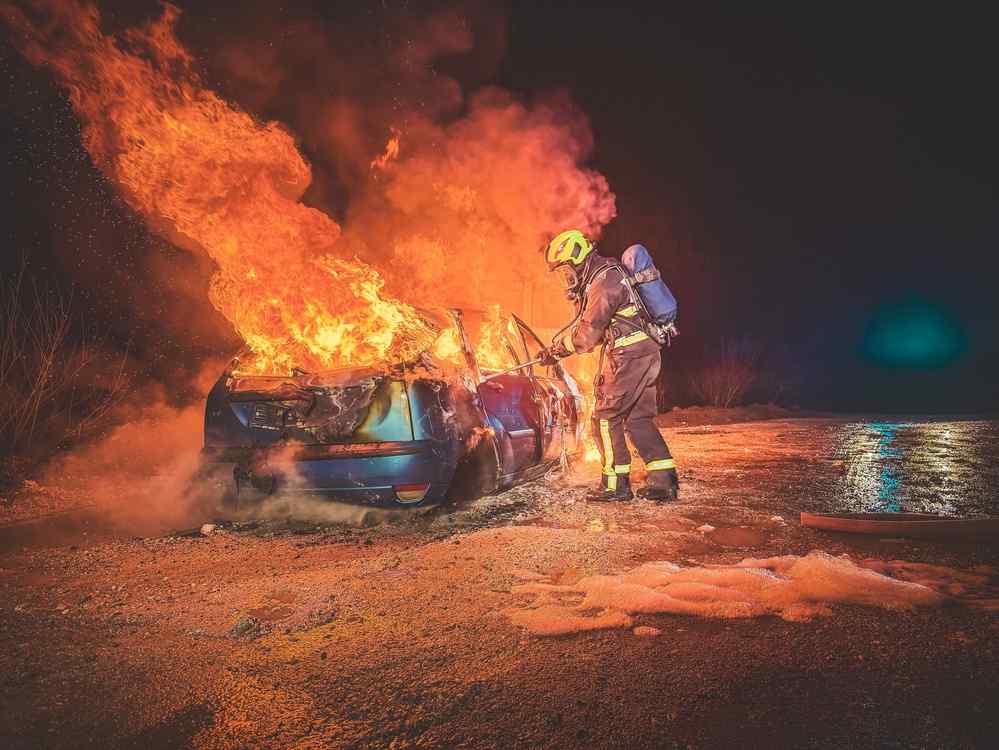
A serious crash in Antioch can become much more dangerous if the vehicle catches fire and someone inside cannot get out. Sometimes, the crash itself might not be fatal, but a faulty fuel system, battery, door, or restraint can create a new and deadly risk. When we look into these cases, we go beyond just figuring out who caused the crash. We also check if the vehicle worked as safely as it should have after the impact and if a defect made the injuries or death worse. Illinois law allows product-liability claims when a faulty vehicle design adds to the injuries, even if it did not cause the crash. For families dealing with severe burns or the loss of a loved one, understanding this difference can change the entire legal case.
Most automobile accident investigations begin by determining why the vehicles collided. A driver may have been speeding, distracted, impaired, following too closely, or violating another traffic law. That driver may be legally responsible for causing the initial impact.
Another important question comes up if the vehicle itself makes the injuries much worse. Illinois recognizes the crashworthiness doctrine, which means a car maker can be held responsible if a design flaw does not cause the crash but does make the injuries worse.
The Illinois Supreme Court addressed this concept in Buehler v. Whalen, a case involving an automobile that caught fire after a collision. The court recognized that manufacturers must account for the foreseeable reality that motor vehicles will sometimes be involved in collisions and can be liable when a defective design creates an unreasonable risk of injury during such an event.
This difference is very important. There may be a claim against the driver who caused the crash and a separate claim against the manufacturer or company whose faulty product led to the fire, entrapment, burns, or death.
A fire after a crash does not always mean the vehicle was defective. Serious crashes can cause fires even if everything works as it should. Our job is to find out what really happened and if the vehicle created an unreasonable risk.
In gasoline-powered vehicles, we may examine the fuel tank, filler system, fuel lines, fuel pump, connections, shielding, and surrounding structure. A rupture or fuel leak can create an ignition source after impact. In electric vehicles, an investigation may focus on the battery pack, protective structure, individual cells, electrical systems, and whether crash forces contributed to thermal runaway or another fire mechanism.
We also look beyond what started the fire. An occupant may survive the original impact but become trapped because a door cannot be opened, a latch fails, the passenger compartment deforms excessively, a restraint cannot be released, or electrical power to an electronic door-release system is lost. The legal question can therefore involve both fire prevention and whether the vehicle provided a reasonable means of surviving and escaping after a foreseeable collision.
Illinois law broadly defines a product-liability action as a claim involving personal injury or death allegedly resulting from a product’s manufacture, construction, assembly, testing, design, characteristics, warnings, repair, maintenance, or other product-related features. See 735 ILCS 5/13-213(a). Motor vehicles and their components fall within this framework.
A vehicle defect case may involve strict product liability, negligence, or other legally supported theories depending on the evidence. A strict-liability design claim focuses heavily on whether the product was unreasonably dangerous when it left the defendant’s control and whether that condition proximately caused the injury.
Illinois design-defect law also considers how consumers reasonably expect a product to perform and the risks and benefits of the challenged design. In Mikolajczyk v. Ford Motor Co., the Illinois Supreme Court addressed the consumer-expectation and risk-utility approaches used in determining whether a vehicle design was unreasonably dangerous.
In a post-crash fire case, this may require detailed engineering evidence concerning crash forces, alternative designs, fire behavior, occupant survival, and the manner in which the allegedly defective component performed.
An automobile does not have to cause the original collision for its manufacturer potentially to bear responsibility for injuries. Illinois courts recognize that a vehicle should be designed with foreseeable crashes in mind. The crashworthiness principle addresses situations where a design defect increases the severity of injuries during or after the collision. Federal courts applying Illinois law have likewise recognized Illinois’s adoption of this doctrine.
For example, another driver might negligently strike your vehicle at an intersection. That driver could be responsible for causing the crash. If the struck vehicle then experiences a defective fuel-system failure that causes a preventable fire, the vehicle manufacturer could potentially bear responsibility for injuries attributable to the defective condition.
The factual analysis can become highly technical. We may need to determine whether the occupant would likely have survived the initial impact, when the fire began, how rapidly it spread, why the occupant could not escape, and whether a safer design could have reduced the harm.
One of the most important pieces of evidence in a post-collision fire case is often the vehicle itself. We generally want the vehicle preserved before it is destroyed, dismantled, sold for salvage, or materially altered. Engineers may need to examine the fuel system, battery, door latches, restraints, wiring, passenger compartment, fire patterns, and areas of structural deformation. Electronic data may also need to be retrieved when available.
Photographs alone may not provide enough information to establish how a component failed. The physical vehicle can contain evidence showing the origin and progression of the fire and whether a particular structure or mechanism failed during the collision.
We may also investigate recalls, technical information, prior incidents involving comparable vehicles, manufacturer testing, design history, maintenance records, repair records, emergency-response documentation, photographs, video, and event data recorder information.
The earlier this evidence is protected, the better our ability to investigate the actual cause of the catastrophic injuries.
Manufacturers frequently argue that another person caused the collision or that the injured occupant contributed to the accident. Illinois’s modified comparative-fault statute, 735 ILCS 5/2-1116, applies to negligence claims and product-liability claims based on strict tort liability.
Under the statute, a plaintiff generally cannot recover if the plaintiff’s contributory fault is more than 50 percent of the proximate cause of the injury or damage. When the plaintiff’s share is 50 percent or less, damages may be reduced according to the percentage of fault attributed to that plaintiff.
That rule does not automatically eliminate a vehicle-defect claim because someone else caused the initial crash. The collision and the enhanced injuries caused by an allegedly defective vehicle can involve separate questions of causation.
We carefully distinguish between conduct that caused the impact and a defect that allegedly caused the occupant to suffer injuries beyond those that otherwise would have occurred.
When an occupant dies because of injuries associated with a defective vehicle and post-crash fire, Illinois’s Wrongful Death Act may provide an important remedy.
Under 740 ILCS 180/1, liability may arise when a person’s death is caused by a wrongful act, neglect, or default that would have allowed the injured person to maintain an action if death had not occurred.
A wrongful death action is generally brought by the decedent’s personal representative for the benefit of the surviving spouse and next of kin. Under 740 ILCS 180/2, recoverable damages can include fair and just compensation for pecuniary injuries as well as grief, sorrow, and mental suffering. Illinois law also permits punitive damages when legally applicable.
The damages depend on the facts of the family relationship and the evidence. They may involve lost financial support, lost services, loss of society, grief, sorrow, and mental suffering.
A wrongful death claim focuses principally on losses experienced by surviving family members. A survival action addresses certain claims that the injured person could have pursued had he or she survived.
Illinois’s Survival Act, 755 ILCS 5/27-6, provides that actions to recover damages for personal injuries survive the injured person’s death. The statute now expressly includes punitive damages when otherwise applicable, subject to statutory limitations.
This distinction may be particularly significant when a vehicle occupant survives the initial impact but suffers severe burns or conscious pain before death. Medical records, witness accounts, emergency-response records, and other evidence may become important when evaluating damages.
Wrongful death and survival claims serve different purposes, so we examine both when handling a fatal vehicle-fire case.
Vehicle-fire litigation should not be delayed. Illinois generally requires personal-injury actions to be filed within two years after the cause of action accrues under 735 ILCS 5/13-202, subject to exceptions that may apply in particular circumstances.
Product-liability cases can also raise additional issues under 735 ILCS 5/13-213, including rules concerning when product-liability actions must be commenced. Because the statute has a complicated legislative history and particular provisions can depend on the claim and product involved, we evaluate the applicable deadlines based on the specific facts rather than assuming that every automotive case has an identical filing period.
Waiting can create another problem even before a statutory deadline expires: evidence can disappear. A destroyed vehicle may be scrapped, surveillance video can be overwritten, witnesses can become difficult to locate, and electronically stored information can be lost.
Prompt investigation is therefore important in suspected design-defect cases.
A severe automobile fire requires a different investigation from a routine collision. We need to determine not only why the vehicles collided, but why the fire occurred, whether the passenger compartment remained survivable, why an occupant could not escape, and whether the vehicle contained a defective condition that contributed to catastrophic injury or death.
At The Law Offices of Robert T. Edens, P.C., we represent people injured in serious motor vehicle accidents in Antioch and throughout Illinois. When a suspected vehicle defect is involved, we can evaluate the collision, identify potentially responsible parties, work to preserve crucial evidence, and determine whether Illinois negligence, product-liability, wrongful-death, or survival laws may apply.
If you or a loved one suffered catastrophic burns after becoming trapped inside a vehicle, or if a family member died in a post-collision vehicle fire, we encourage you to obtain legal advice before the vehicle or other important evidence is destroyed. Contact our Antioch auto accident attorney at The Law Offices of Robert T. Edens, P.C. today at 847-395-2200 to schedule your free consultation.

The Law Offices of Robert T. Edens, Personal Injury and Workers' Compensation Law Office, have offices in Antioch, Waukegan, Grayslake, Woodstock and Barrington. We represent clients throughout the communities of Antioch, Waukegan, Grayslake, Barrington, Woodstock, Buffalo Grove, Deer Park, Gurnee, Lake Zurich, Round Lake, McHenry, Cary, Crystal Lake, Libertyville, Lincolnshire, Mundelein, Vernon Hills, Wheeling, North Chicago, Zion, Inverness, Palatine, Wauconda, Island Lake, Fox Lake, Barrington Hills, Spring Grove, Lake Bluff, Lakemoor, Long Grove, Lake Villa, Kildeer, Wadsworth, Indian Creek, Fox River Grove, Lindenhurst and other cities within Lake and McHenry Counties Illinois.
© 2026 The Law Offices of Robert T. Edens, LLC., All Rights Reserved, Reproduced with Permission Privacy Policy | Sitemap | Disclaimer
Powered By