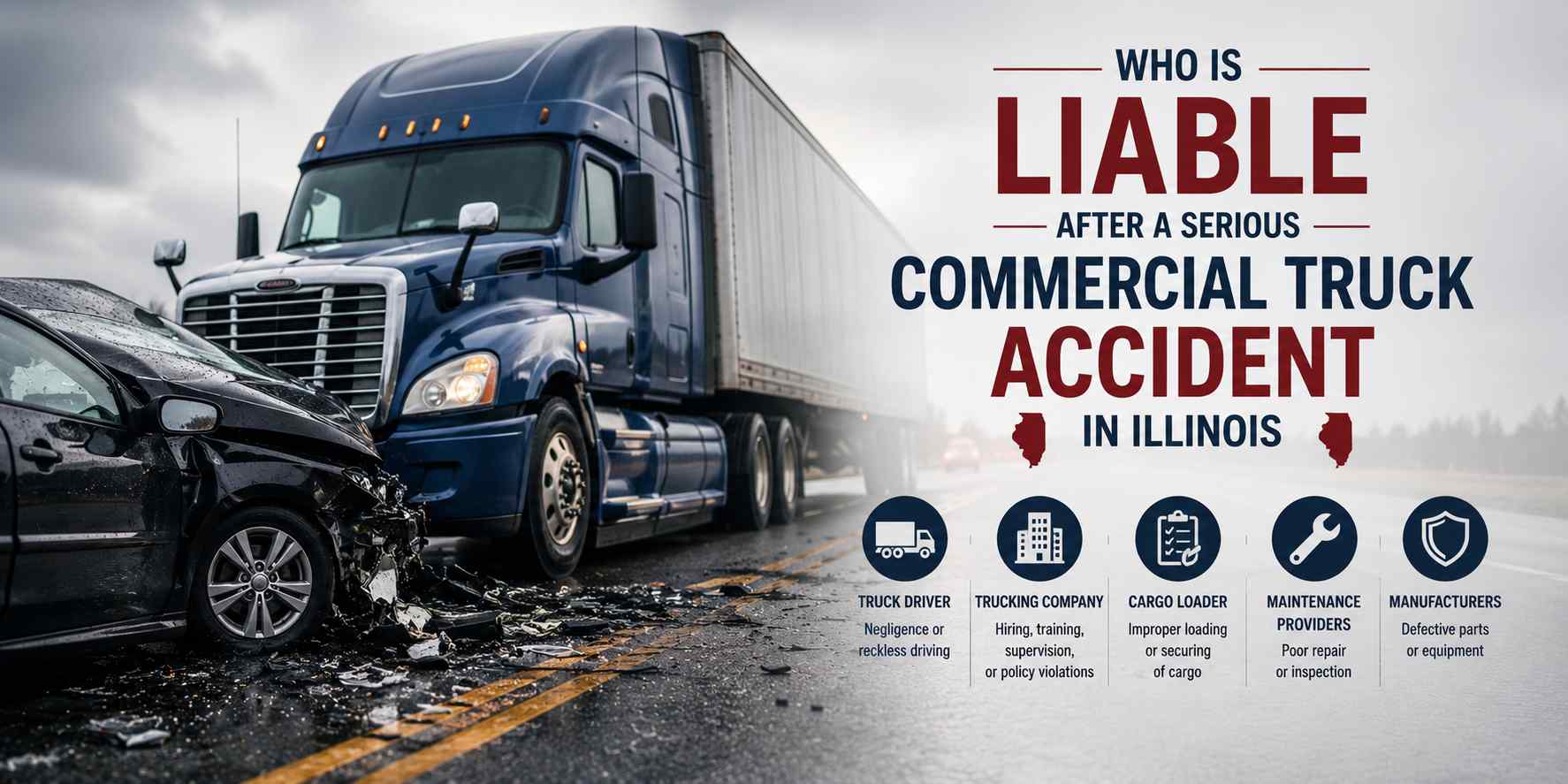
Being hit by a commercial truck can leave you with injuries that affect your ability to work, care for your family, or live on your own. These accidents are often more complicated than regular car crashes because the truck driver might not be the only one at fault. The trucking company, trailer owner, maintenance crew, cargo business, or other companies could also be responsible.
To figure out who is liable, we look at more than just the moments before the crash. We examine the choices that led to the truck being on the road. At The Law Offices of Robert T. Edens, P.C., we investigate serious truck accidents in Antioch to find out who is responsible and to seek full compensation for our clients’ injuries and losses.
We usually start our investigation by looking at what the truck driver did. Commercial drivers spend long hours behind the wheel of vehicles that are much heavier than regular cars. Speeding, not keeping enough distance, being distracted or tired, driving under the influence, or not reacting properly to traffic can all lead to serious accidents.
Illinois traffic laws apply to commercial drivers as well as other motorists. For example, 625 ILCS 5/11-710 requires a driver to maintain a reasonable and prudent following distance based on vehicle speed, traffic, and highway conditions. The statute also contains additional spacing requirements applicable to certain trucks outside business and residential districts.
When we look into possible driver negligence, we check if the trucker was speeding, tailgating, distracted by a phone or device, driving while tired, making unsafe lane changes, or not adjusting for weather, traffic, or road work. A citation can provide useful evidence, but liability does not depend solely on whether the police issued a ticket. We independently examine the evidence to determine how the collision occurred.
One of the most important questions after a commercial truck accident is who employed or controlled the driver. A trucking company may face liability based on the conduct of a driver acting within the scope of employment. Depending on the facts and applicable law, claims may also concern the company’s own conduct, including hiring, supervision, training, maintenance, or other safety-related decisions.
For example, we may discover that a company put a driver behind the wheel despite warning signs in the driver’s history. Other cases involve inadequate training, pressure to meet unrealistic schedules, or failure to address known safety problems.
Trucking companies and their insurers may begin investigating a serious crash almost immediately. We therefore work to identify and preserve relevant company records before important evidence is lost under ordinary document-retention practices or becomes more difficult to obtain.
Fatigue is especially dangerous when someone is operating a tractor-trailer. A tired driver may have slower reaction times, impaired judgment, reduced awareness, or difficulty staying within a lane.
Commercial motor carriers and qualifying drivers engaged in interstate commerce are subject to federal hours-of-service requirements. These rules regulate driving and on-duty periods and generally require qualifying drivers to maintain records of duty status through electronic logging devices when applicable.
When fatigue is suspected, we may seek electronic logging information, dispatch communications, GPS records, fuel receipts, delivery records, toll information, and other evidence showing where the truck traveled and when.
Those records can tell a much broader story than a driver’s statement after the accident. They may show whether the driver had adequate rest or whether scheduling and operational practices contributed to unsafe driving.
Not every truck accident is caused solely by driver error. A commercial vehicle depends on brakes, tires, steering components, lights, coupling systems, and other equipment functioning properly. A mechanical failure at highway speed can make an already dangerous vehicle nearly impossible to control.
We investigate whether maintenance was performed properly and whether known defects were corrected. Maintenance records, inspection reports, repair invoices, prior driver complaints, and post-crash inspections may become critical evidence.
The legal responsibility may extend beyond the trucking carrier if another business owned, leased, inspected, repaired, or maintained the tractor or trailer and its negligence contributed to the collision.
The contents of a trailer can affect how a commercial truck handles. Cargo that is improperly distributed or secured can shift during braking or turning. Excessive weight can affect stopping distance and vehicle control. In severe cases, shifting cargo can contribute to rollovers, jackknifes, loss of control, or cargo spilling onto the roadway.
The company responsible for loading or securing the shipment may therefore become an important part of our investigation. We may examine bills of lading, weight records, loading documentation, photographs, cargo securement information, and agreements among the businesses involved in transporting the shipment.
Sometimes a truck or one of its components fails despite the driver operating the vehicle appropriately. A defective tire, braking component, steering system, coupling mechanism, or other part may contribute to a collision. When the evidence points toward a defective product, the manufacturer, distributor, or another party within the commercial chain may potentially face liability under applicable Illinois product-liability principles.
These cases require us to preserve the vehicle and failed components whenever possible. Allowing a truck, tire, brake assembly, or other critical component to be repaired, destroyed, or returned to service can eliminate evidence needed to determine what went wrong. For that reason, early preservation efforts can be particularly important after catastrophic commercial vehicle crashes.
Serious trucking accidents often involve multiple defendants. Illinois law specifically addresses how damages may be allocated when more than one party bears responsibility. Under 735 ILCS 5/2-1117, defendants found liable in qualifying bodily injury or death cases are jointly and severally liable for the plaintiff’s past and future medical and medically related expenses. For other damages, a defendant whose fault is less than 25% of the total fault considered under the statute is generally severally liable, while a defendant whose fault is 25% or greater is generally jointly and severally liable.
This can become significant when a truck driver, motor carrier, maintenance business, or another defendant contributed to the same accident. We investigate every reasonable source of liability rather than assuming the driver is the only party who should answer for the harm caused.
Insurance companies may try to place some responsibility on the injured driver. Illinois follows a modified comparative negligence system. Under 735 ILCS 5/2-1116, you are barred from recovering damages if your contributory fault is found to be more than 50% of the proximate cause of the injury. If your fault is 50% or less, you may still recover, but your damages are reduced according to your percentage of fault.
For example, if damages were determined to be $1 million and the injured person was found 10% responsible, the recoverable damages would generally be reduced by 10%, leaving $900,000. Because percentages of fault directly affect compensation, we do not treat allegations of comparative negligence casually. We use physical evidence, witness accounts, vehicle data, photographs, video, and other available evidence to challenge unsupported attempts to shift blame.
Commercial trucks may contain or generate valuable electronic evidence. Depending on the vehicle and systems involved, this may include engine control module information, electronic logging records, GPS information, telematics, and other operational data.
We may also seek:
We also examine police reports, witness statements, medical documentation, and physical damage to the vehicles. A serious truck accident case can depend on evidence that the injured person never knew existed. Identifying it early can make a substantial difference.
A catastrophic truck collision may create losses that continue for decades. We do not evaluate these cases based only on the hospital bills that have already arrived. Depending on the circumstances, compensation may include past and future medical expenses, lost income, diminished earning capacity, pain and suffering, disability, disfigurement, and other damages allowed under Illinois law.
Future losses can be particularly important when injuries involve the brain, spinal cord, severe orthopedic damage, amputations, permanent nerve damage, or other lasting conditions.
Our responsibility is to understand what the injury has already cost you and what it is reasonably expected to cost in the future before determining the value of the claim.
Waiting too long to pursue a truck accident claim can affect your legal rights. Under 735 ILCS 5/13-202, an action for damages for personal injury generally must be commenced within two years after the cause of action accrues. Certain cases can involve different deadlines, exceptions, or additional notice requirements, so we do not recommend assuming that two years will apply to every situation.
The practical reason for acting promptly goes beyond the filing deadline. Trucking records can disappear, witnesses can become harder to locate, vehicles can be repaired, and electronic information may be overwritten. The earlier we can investigate a serious commercial truck accident, the greater our opportunity to preserve evidence concerning what happened and who was responsible.
A commercial truck accident can involve much more than determining whether the truck driver made a mistake. We may need to examine the conduct of the motor carrier, maintenance companies, cargo businesses, vehicle owners, manufacturers, and other parties before we know who should be held responsible.
At The Law Offices of Robert T. Edens, P.C., we represent people injured in serious motor vehicle accidents in Antioch and throughout Illinois. We investigate the circumstances surrounding the collision, preserve evidence, identify potentially responsible parties, document our client’s losses, and pursue the compensation available under Illinois law.
If you or someone in your family was seriously injured in a commercial truck accident, contact our Antioch truck accident attorney at The Law Offices of Robert T. Edens, P.C., by calling 847-395-2200 to receive a free consultation. We can review how the crash occurred, determine which companies and individuals may be legally responsible, and discuss the compensation you may be entitled to pursue under Illinois law.

The Law Offices of Robert T. Edens, Personal Injury and Workers' Compensation Law Office, have offices in Antioch, Waukegan, Grayslake, Woodstock and Barrington. We represent clients throughout the communities of Antioch, Waukegan, Grayslake, Barrington, Woodstock, Buffalo Grove, Deer Park, Gurnee, Lake Zurich, Round Lake, McHenry, Cary, Crystal Lake, Libertyville, Lincolnshire, Mundelein, Vernon Hills, Wheeling, North Chicago, Zion, Inverness, Palatine, Wauconda, Island Lake, Fox Lake, Barrington Hills, Spring Grove, Lake Bluff, Lakemoor, Long Grove, Lake Villa, Kildeer, Wadsworth, Indian Creek, Fox River Grove, Lindenhurst and other cities within Lake and McHenry Counties Illinois.
© 2026 The Law Offices of Robert T. Edens, LLC., All Rights Reserved, Reproduced with Permission Privacy Policy | Sitemap | Disclaimer
Powered By